

- Español
- 中文
News
Lighting After Paris: What Maison&Objet 2026 Is Quietly Telling Us About the Next Interior Trend
Author:Stella Choi
Click:
Time:2026-09-16 11:38:43
Lighting After Paris: What Maison&Objet 2026 Is Quietly Telling Us About the Next Interior Trend
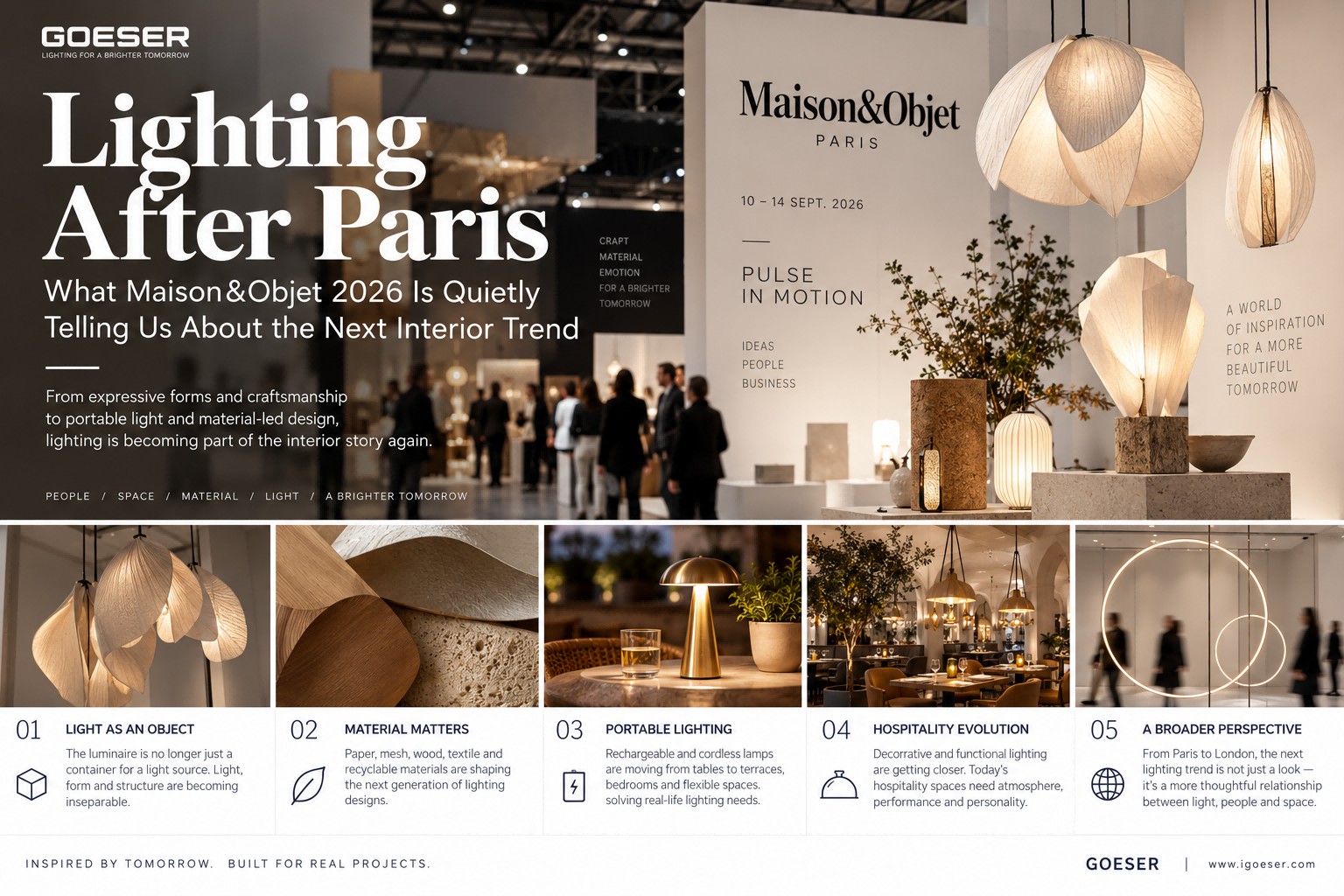
Paris has just finished another September design week. Beyond the colours, installations and new collections, one message stood out for the lighting industry: light is becoming part of the object, the material and the interior story again.
Maison&Objet Pulse, held in Paris from September 10–14, brought together around 1,700 brands from 49 countries under this year’s theme, “Pulse in Motion.”
For lighting professionals, however, the interesting part was not simply the scale of the show.
It was what designers were doing with light.
At a time when lighting discussions are often dominated by efficiency, controls, optics and specifications, Paris offered a useful reminder: people still experience light through objects, materials and spaces.
And several signals from this European design season may be worth watching well beyond Paris.
Light Is Becoming an Object Again
One particularly interesting signal came from Maison&Objet’s Future On Stage programme.
The three selected emerging names — Baguette Studio, Risette and LightMass — all explored light in very different ways.
Baguette Studio works with plant-based and beeswax materials to create softly illuminated objects.
Risette uses cardboard, paper, colour and interaction to turn lamps into playful objects that can change the way a space is perceived.
LightMass, a project by Raw-Edges Studio, takes another direction: lightweight LED structures where light, mesh and form become almost inseparable.
Different materials. Different aesthetics. Different technologies.
But the underlying idea is surprisingly consistent:
The luminaire is no longer just a container for a light source.
Light itself is becoming part of the structure.
For manufacturers, this distinction matters.
For years, LED development encouraged the industry to make luminaires thinner, smaller and less visible. That evolution will continue, especially in architectural and commercial lighting.
But decorative lighting appears to be moving simultaneously in another direction.
The object is allowed to be visible again.
Not necessarily bigger. Not necessarily more decorative.
Just more intentional.
Materials Are Doing More of the Design Work
Another noticeable direction is the renewed importance of materials.
Paper, mesh, wax, wood, textile-like surfaces, translucent structures and recyclable materials are appearing not simply as decoration, but as part of the way light is shaped and experienced.
This is different from an earlier wave of “natural style” lighting where adding rattan, wood grain or a woven shade was sometimes enough to make a product feel contemporary.
The newer approach feels more integrated.
The question is becoming:
What happens when light passes through, reflects from, or interacts with the material?
That changes product development.
A paper surface is no longer only a paper surface. Its translucency matters.
A mesh is not simply a decorative texture. Its density and distance from the LED affect the visual effect.
A piece of wood is not automatically “natural design.” Its proportion, finishing, construction and relationship with the light source determine whether the product feels considered or generic.
For lighting manufacturers developing new collections for Europe, this may be one of the more useful lessons from the current design season:
Material selection should begin earlier in the lighting design process, not at the end as decoration.
Less Decoration Does Not Mean Less Personality
There is another shift worth watching.
Many contemporary interiors are becoming visually quieter, but the lighting inside them is not necessarily becoming anonymous.
The personality is simply moving somewhere else.
Instead of complicated ornamentation, it may come from a folded surface.
A shadow.
A translucent layer.
A deliberately exposed structure.
A small change in proportion.
Or the way a luminaire looks when it is switched off.
That last point is particularly important for decorative lighting.
A lamp may operate for only part of the day, but it remains an object in the room all day.
That means a successful luminaire increasingly has two jobs:
It has to work as light when it is on, and work as an object when it is off.
This sounds obvious, but it changes many design decisions.
It also explains why simply adding another decorative element does not necessarily make a product more desirable.
Sometimes removing one does.
Portable Light Is Becoming Part of the Interior Landscape
Another category we continue to watch closely is portable and rechargeable lighting.
Cordless table lamps are no longer limited to restaurant tables.
They are moving through homes, terraces, hospitality spaces, balconies, bedside areas and increasingly flexible interiors.
This reflects a wider change in how people use space.
Furniture moves.
Dining happens in different places.
A balcony becomes an evening workspace.
A restaurant changes its table layout.
A hotel wants to create atmosphere without adding another fixed electrical point.
In those situations, portable lighting is not simply a cordless version of a table lamp.
It solves a spatial problem.
That distinction matters because the next generation of rechargeable lamps will probably not win only by offering a larger battery or another touch dimmer.
The better question is:
Where does the user want light when there is no convenient electrical point?
Once that question is asked, product development starts to look different.
Weight matters.
Balance matters.
Charging behaviour matters.
The way the lamp is carried matters.
So does what it looks like when several units are placed together in a hospitality environment.
Portable lighting is therefore becoming less of a novelty category and more of a genuine interior-lighting tool.
Hospitality Is Blurring the Line Between Decorative and Technical Lighting
Maison&Objet’s own focus on hospitality is another useful signal.
Hotels, restaurants and public spaces increasingly sit between several traditional lighting categories.
They need atmosphere, but they also need performance.
They need decorative identity, but maintenance still matters.
They need comfortable light on a table, sufficient illumination for circulation, good colour appearance, controllability and products that survive repeated daily use.
This is where the old distinction between “decorative lighting” and “technical lighting” becomes less useful.
A beautiful restaurant pendant with uncomfortable glare is not a successful hospitality product.
Neither is a technically excellent luminaire that destroys the atmosphere the interior designer is trying to create.
The opportunity is increasingly in the middle:
technical thinking inside a product people actually want to see.
For manufacturers, this requires cooperation between industrial design, optical engineering, electronics and production much earlier in development.
Good lighting cannot be added after the shape has already been decided.
Meanwhile, London Is Continuing the Conversation
Paris is not happening in isolation.
London Design Festival is taking place immediately afterwards, and lighting again has a visible presence.
Tom Dixon is presenting his latest collections in London after earlier launches in Milan and Copenhagen, while Lee Broom is using The Chant Chambers to explore new interpretations of one lighting family across chandeliers, wall lights, linear pendants and architectural structures.
That is another interesting lesson for manufacturers.
A successful lighting idea does not always need to become twenty unrelated products.
Sometimes the stronger strategy is to develop one recognisable design language into a coherent family.
Pendant.
Wall light.
Table lamp.
Floor lamp.
Different scale.
Different application.
Same DNA.
For buyers and brands, a family is easier to merchandise.
For designers, it creates continuity across a project.
For manufacturers, it can also create opportunities to share materials, components, finishes and manufacturing processes.
Good design and sensible industrialisation do not have to work against each other.
What Does This Mean for Lighting Product Development?
Trade shows are full of beautiful things.
The difficult part is deciding which ideas deserve to leave the exhibition hall and enter a product roadmap.
Not every sculptural lamp should become a mass-market product.
Not every material experiment can survive production tolerances, packaging, certification, transportation and target pricing.
And not every trend belongs in every market.
For lighting manufacturers, the useful work starts after the inspiration.
Can the structure be manufactured consistently?
Can unnecessary tooling be avoided?
Can components be shared across a family?
Can the product be packed efficiently?
Can the light source be serviced or replaced where the market requires it?
Does the material still look good after repeated production?
Does the design work at the buyer’s target price?
And most importantly:
Does the product solve a real need, or does it only photograph well?
That is where trend observation becomes product development.
The Next Lighting Trend May Not Be a “Look”
After Paris, it is tempting to summarise the season with a colour palette, a material list or five visual trends.
But that may miss the more important change.
The next direction in lighting does not appear to be one particular shape.
It is a different relationship between light, object, material and space.
Decorative products are being asked to think more carefully about light.
Technical products are being asked to think more carefully about the interior.
Portable products are being asked to solve real spatial behaviour.
Hospitality lighting is being asked to do all three.
Perhaps that is the most useful message from this European design season.
The opportunity is not to add more decoration to a lamp.
It is to make technical lighting feel more considered, and decorative lighting work harder.
At GOESER, we follow European lighting, interior and retail developments not simply to reproduce what is already on the market, but to understand where product expectations are moving — and how those ideas can be translated into lighting that is manufacturable, commercially realistic and relevant to real projects.
Developing a new lighting collection or sourcing for an upcoming project?
Share your application, target market, design direction, quantity and key technical requirements with us. We can discuss suitable product platforms, customisation possibilities and manufacturing options for your next project.

点击右上角
分享给朋友吧







 Long by picture save/share
0
你的喜欢,就是我坚持写下去的能量器
YouArticle
已有0人推荐


CONTACT US
 4F. ***5, ErJia Village, Xilian, JingSha, Danzao Town, Nanhai Dist, Foshan, GuangDong, PRC.
 0086 136 3007 3564

 Whatsapp / Wechat: +86 1363 0073 564
© Copyright 2023-2024 Foshan GuanSheng Technology Co., Ltd. All Rights Reserved.
