

- Español
- 中文
News
LED Batten Light ODM: Why the Same 1200mm, 22W, 110 lm/W Spec Can Produce Very Different Quotes
Author:Stella Choi
Click:
Time:2026-09-12 16:54:47
LED Batten Light ODM: Why the Same 1200mm, 22W, 110 lm/W Spec Can Produce Very Different Quotes
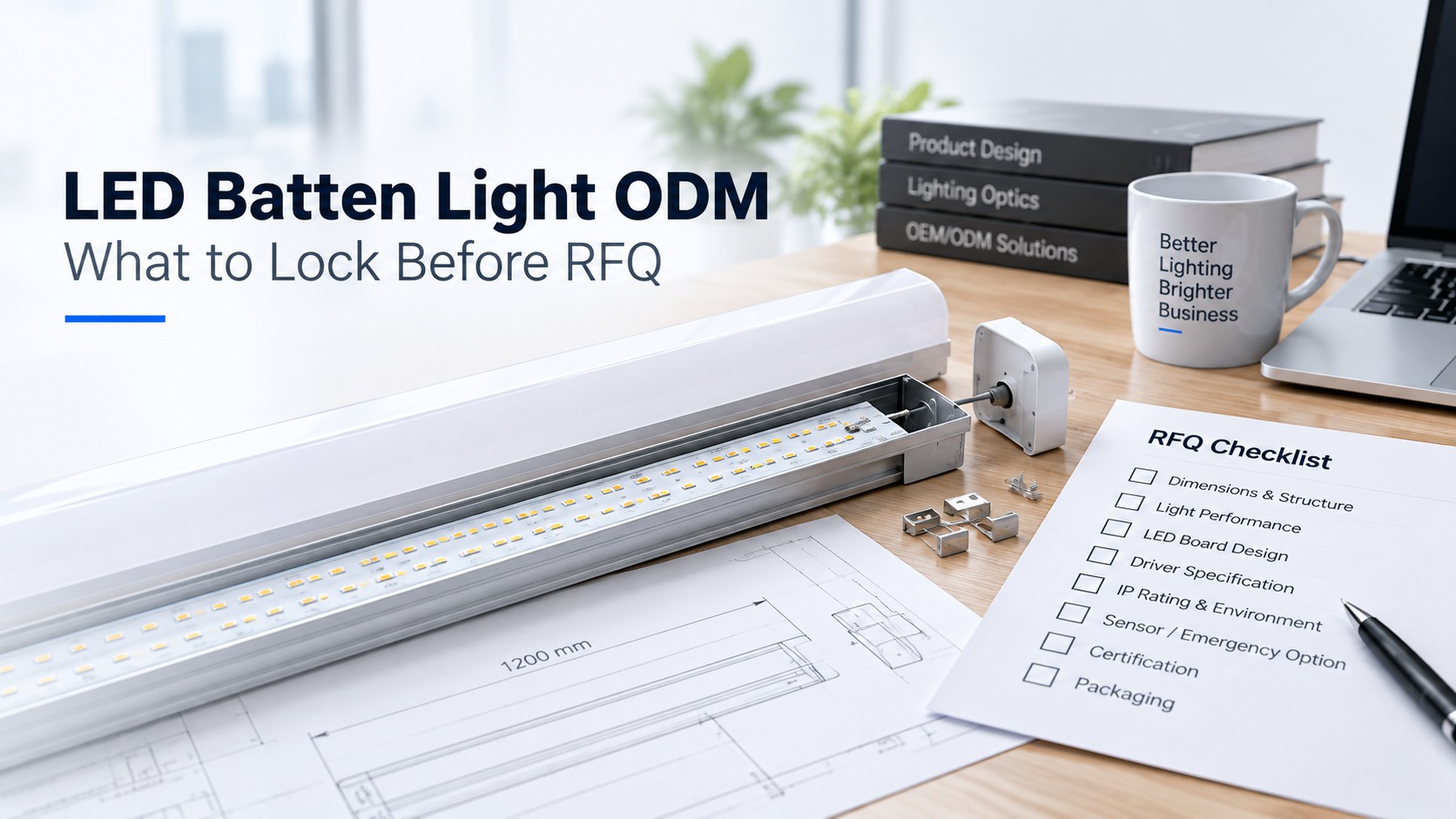
A buyer sends a reference photo and a short message:
1200 mm.
22 W.
110 lm/W.
4000 K.
Please quote your best price.
Within one day, five suppliers send five very different prices.
The natural question is:
Who is expensive?
But that may be the wrong question.
A better one is:
Are all five factories actually quoting the same product?
In LED batten light ODM projects, a short specification can hide surprisingly large differences in construction, driver quality, thermal design, sensor performance, installation method and testing requirements.
Two products can both be described as a 1200mm 22W LED batten light at 110 lm/W, yet behave very differently after installation.
Before comparing quotations, buyers should first make sure the suppliers are quoting the same target.
1. Start With the Application, Not the Wattage
The first question should not be:
“How many watts?”
It should be:
“Where will this batten be installed?”
A linear batten for a supermarket backroom is not necessarily the same product as one intended for:
- parking areas,
- warehouses,
- workshops,
- stairwells,
- utility rooms,
- corridors,
- cold storage,
- covered outdoor locations,
- or industrial service areas.
The application affects decisions about:
IP protection, impact resistance, diffuser material, mounting method, sensor type, emergency function and operating temperature.
If the application is unclear, suppliers often quote whatever existing model comes closest.
That produces a price comparison.
It does not necessarily produce a meaningful product comparison.
2. “1200mm” Is Still Not a Complete Mechanical Specification
A 1200mm batten LED light fitting sounds specific.
It is not.
Two fixtures with approximately the same external length may use completely different constructions.
One may use:
- thin stamped steel,
- a simple plastic diffuser,
- basic end caps,
- and an economy driver.
Another may use:
- heavier aluminium or steel construction,
- reinforced mounting points,
- better cable entry,
- improved seals,
- a more stable diffuser,
- and a larger driver compartment.
Both fit into the same 1200 mm category.
Their quotations should not be expected to match.
For an ODM project, buyers should define at least:
overall dimensions, housing material, housing thickness where relevant, diffuser material, cable entry, mounting arrangement and required IP rating.
3. 22W Tells You Power Consumption. It Does Not Tell You Light Quality.
Suppose the RFQ asks for:
22 W, 110 lm/W
That implies approximately:
2,420 lumens
on paper.
But even this number needs context.
Is 110 lm/W the:
- LED package efficacy?
- LED board efficacy?
- initial luminaire efficacy?
- tested system efficacy after driver and optical losses?
Those are not the same thing.
For commercial purchasing, the useful number is normally the complete luminaire performance, measured under defined conditions.
Otherwise two factories may both write “110 lm/W” while calculating it differently.
This is one of the easiest ways for apparently identical quotations to become incomparable.
4. Ask What Is Behind the Diffuser
This is where many price differences begin.
The LED board can vary in:
- PCB material,
- copper thickness,
- LED quantity,
- LED current,
- component spacing,
- thermal path,
- connector design,
- and operating temperature.
A product designed to reach the target lumen output by driving fewer LEDs harder may initially meet the specification.
A different design may use more LEDs at lower current.
The second solution can cost more.
It may also operate differently thermally and electrically over long service hours.
That is why a serious LED batten ODM discussion should include more than:
“2835 LED, 22 W.”
The question is not only which LED is used.
The question is:
how is the LED system being operated?
5. The Driver Can Quietly Change the Entire Product
Drivers are often hidden inside the housing, which makes them easy to ignore during price comparison.
But they influence:
- power factor,
- THD,
- flicker behaviour,
- start-up performance,
- dimming compatibility,
- protection behaviour,
- lifetime expectations,
- and EMC performance.
The applicable safety requirements for LED controlgear continue to evolve. IEC 61347-2-13:2024, for example, covers safety requirements for electronic controlgear used with LED light sources.
For the buyer, however, the practical lesson is simpler:
Do not specify only “good driver”.
Define what “good” means for the project.
For example:
- PF requirement
- THD requirement
- flicker requirement
- dimming protocol
- surge requirement
- operating voltage
- driver brand requirement, if any
- warranty expectation
Those items can change the quotation quickly.
And legitimately.
6. Dustproof Is Not a Specification
One of the queries buyers use is:
dustproof LED batten linear light
But “dustproof” is still marketing language unless it is tied to a defined enclosure rating.
A fixture for a dry storeroom does not need the same protection as one used in a dusty workshop or damp service area.
So instead of requesting:
Dustproof batten light
request:
Required IP rating: ___
Installation environment: ___
Indoor / semi-outdoor: ___
Cleaning method: ___
That gives the supplier something engineering can actually work with.
It also prevents over-specification.
There is no commercial advantage in paying for an unnecessary enclosure level simply because a product description sounds stronger.
7. Sensor Versions Need Their Own RFQ
“Sensor batten” is another deceptively short description.
Buyers should clarify whether they need:
PIR or microwave sensing
and then define:
- detection range,
- mounting height,
- hold time,
- daylight threshold,
- standby level,
- standby duration,
- and grouping behaviour.
A microwave sensor that works well in one corridor may be annoying in another location because it can detect movement through certain lightweight materials or adjacent spaces.
This is not necessarily a sensor defect.
It may simply be the wrong sensor configuration for the application.
So a standard batten and a sensor batten should not be treated as the same RFQ with one extra component added.
8. Emergency Versions Are Also Different Products
The same applies to emergency lighting.
“Emergency version available” is not enough information for a project quotation.
The buyer should define:
- emergency duration,
- emergency output,
- battery chemistry,
- battery capacity,
- charging method,
- indicator requirements,
- test function,
- and applicable market requirements.
A three-hour emergency version with automatic testing is not comparable with a simple low-output emergency battery pack.
Yet both may appear in a quotation under the line:
Emergency option: Yes.
That single word can hide a substantial cost difference.
9. Certification Must Match the Actual Configuration
This point causes trouble surprisingly often.
A supplier may have test reports for:
- the standard version,
- one wattage,
- one driver,
- or one housing construction.
Then the buyer requests:
different wattage + emergency + sensor + new driver + new housing length.
At that point the correct question is not:
“Do you have CE?”
It is:
“Does the requested configuration remain covered by the applicable test documentation?”
General luminaire safety requirements are addressed in the IEC 60598 family, whose current Part 1 edition is IEC 60598-1:2024.
For an ODM project, changing key electrical or mechanical components may affect the compliance route.
That should be discussed before the order, not after production.
10. Packaging Can Change More Than Freight Cost
For distributors and private-label customers, packaging is part of the product.
A project carton and a retail carton are different commercial requirements.
Before requesting the final quotation, clarify:
- neutral or branded packaging,
- colour box or brown box,
- quantity per carton,
- labels,
- barcode,
- instruction manual,
- accessories,
- pallet requirement,
- drop-test expectation,
- and language versions.
Even carton dimensions matter.
For long linear fixtures, packaging design affects:
container utilization, breakage risk and landed cost.
A quotation that is USD 0.30 cheaper at FOB level may not remain cheaper after logistics.
The ODM RFQ Checklist
Before asking factories to quote an LED batten project, buyers can use this simple checklist.
| RFQ Item | What to Define |
|---|---|
| Application | Warehouse, corridor, parking, utility, retail, industrial |
| Length | 600 / 900 / 1200 / 1500 mm or custom |
| Power | e.g. 18 W / 22 W / 36 W |
| System efficacy | e.g. ≥110 lm/W |
| Lumen output | Required luminaire lumen output |
| CCT | 3000K / 4000K / 5000K / 6500K |
| CRI | e.g. Ra ≥80 / ≥90 |
| Housing | Material, dimensions, construction |
| Protection | Required IP / IK where applicable |
| Driver | PF, THD, flicker, dimming, voltage |
| Sensor | None / PIR / microwave and settings |
| Emergency | Duration, output, battery, test function |
| Installation | Surface, suspended, linkable |
| Certification | Target market and required compliance |
| Branding | Logo, label, colour, private mould if applicable |
| Packaging | Neutral / OEM / retail |
| Order quantity | Trial quantity and forecast volume |
A supplier that receives this information can quote much more accurately.
A buyer can also compare quotations much more fairly.
Why the Cheapest Quotation Is Often the Hardest One to Compare
A low quotation is not automatically bad.
An expensive quotation is not automatically better.
The real problem appears when quotations are based on different assumptions.
Supplier A may quote:
standard driver + standard housing + neutral carton.
Supplier B may quote:
low-flicker driver + thicker housing + branded carton + project testing.
Supplier C may quote:
an existing product that looks similar to the reference photo but does not fully meet the RFQ.
Put those three prices into one Excel column and it looks like a supplier-price comparison.
Technically, it is not.
It is a comparison of three different interpretations of the project.
A Better RFQ Process for LED Batten ODM
A practical sourcing sequence looks like this:
Step 1: Define application and target market.
Step 2: Lock the performance specification.
Step 3: Lock mechanical construction.
Step 4: Define driver, sensor and emergency requirements.
Step 5: Confirm compliance requirements.
Step 6: Confirm packaging and expected order volume.
Step 7: Ask suppliers to identify deviations clearly.
That final point matters.
Instead of forcing every factory to answer:
“Yes, we can.”
ask:
“Please quote based on this specification and clearly mark any deviation or alternative proposal.”
That one sentence often makes quotations much easier to evaluate.
Standard Product or Full ODM?
Not every project needs ODM.
If the required product is close to an existing certified platform, modifying:
- wattage,
- CCT,
- branding,
- packaging,
- sensor settings,
- or driver options
may be faster and more economical than creating a new construction.
Full ODM makes more sense when the customer needs a genuinely different:
- housing,
- installation system,
- optical design,
- electrical architecture,
- feature combination,
- or product family.
A good supplier should not push customization simply because customization sounds more impressive.
Sometimes the better engineering decision is:
change less.
It saves tooling cost, certification work and development time.
What Should You Send With Your Next LED Batten RFQ?
At minimum:
- target market
- application
- reference photo or drawing
- dimensions
- wattage
- lumen or lm/W requirement
- CCT and CRI
- IP requirement
- sensor or emergency requirement
- certification requirement
- estimated quantity
With those eleven items, the first quotation becomes far more useful.
Without them, buyers often spend three rounds correcting a price that was never based on the intended product in the first place.
Final Thought
A specification such as:
1200mm + 22W + 110 lm/W
looks precise.
For ODM sourcing, it is only the beginning.
The purpose of a good RFQ is not to make every supplier quote the same price.
It is to make sure they are quoting the same product requirement.
That is when price comparison starts to mean something.
Need an LED Batten ODM Quotation?
GOESER works with commercial lighting projects and OEM/ODM requirements for overseas B2B customers.
Send us your:
application + dimensions + wattage + target performance + quantity + market
and we can first review whether an existing platform can meet the project before recommending unnecessary customization.
Request a project review → Contact GOESER
FAQ
What information is required for an LED batten light ODM quotation?
At minimum, specify the application, dimensions, power, lumen requirement or system efficacy, CCT, CRI, IP rating, driver requirements, sensor or emergency functions, target market and order quantity.
Is 110 lm/W good for an LED batten light?
It can be suitable for many commercial applications, but efficacy alone does not define product quality. Buyers should also evaluate total lumen output, thermal design, driver performance, optical losses and the lighting requirement of the project.
Can a 1200mm LED batten be customized?
Yes. Common customization includes wattage, CCT, driver, sensor, emergency function, housing colour, branding and packaging. Structural modifications may require additional development and compliance evaluation.
What affects LED batten light ODM pricing?
Major cost drivers include housing construction, LED board design, driver specification, sensor or emergency functions, IP protection, certification requirements, packaging and order volume.
Should I choose OEM or ODM for a batten project?
If an existing platform already meets most requirements, OEM customization is often faster and more economical. ODM is more appropriate when substantial structural, electrical or functional changes are required.

点击右上角
分享给朋友吧







 Long by picture save/share
0


CONTACT US
 4F. ***5, ErJia Village, Xilian, JingSha, Danzao Town, Nanhai Dist, Foshan, GuangDong, PRC.
 0086 136 3007 3564

 Whatsapp / Wechat: +86 1363 0073 564
© Copyright 2023-2024 Foshan GuanSheng Technology Co., Ltd. All Rights Reserved.
