

- Español
- 中文
News
How to Get an Accurate Supermarket Lighting Quote: 9 Project Details Buyers Should Send
Author:Stella Choi
Click:
Time:2026-09-04 18:43:48
How to Get an Accurate Supermarket Lighting Quote: 9 Project Details Buyers Should Send
Quick Answer
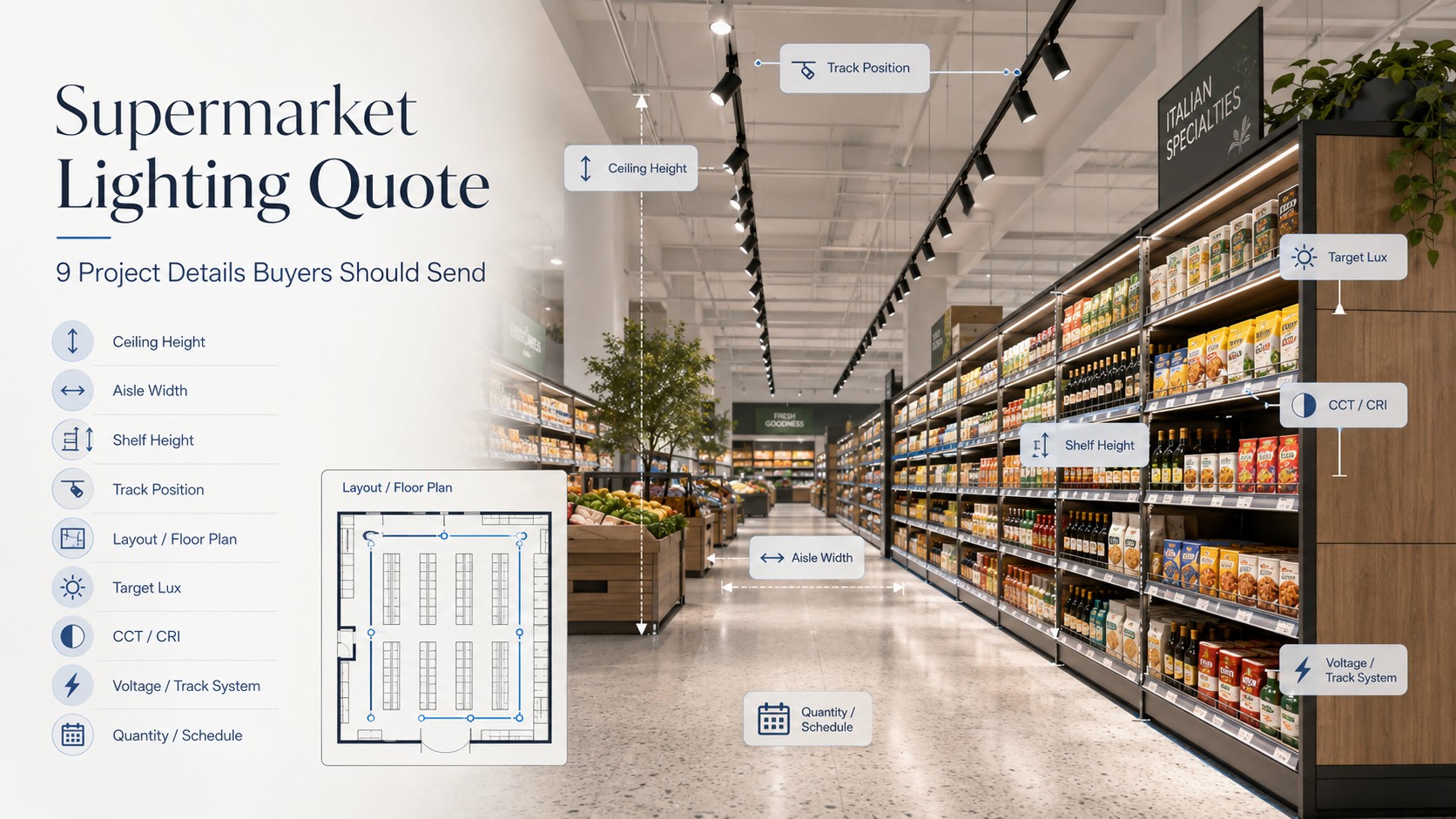
If you are requesting a quotation for a supermarket or retail lighting project, sending only the required wattage and quantity is rarely enough.
For a useful fixture recommendation, a lighting supplier should normally understand at least:
- ceiling height;
- aisle width;
- shelf height;
- track position;
- store or project layout;
- target lighting level;
- required CCT and CRI;
- electrical and track-system requirements;
- estimated quantity and project schedule.
Even when some information is not yet finalized, a floor plan, several site photos and basic dimensions can already help a supplier make a much more relevant recommendation.
The objective is not simply to quote a lamp.
It is to match the luminaire to the space.
Why Does Project Information Matter?
Two supermarkets can have exactly the same floor area and still require very different lighting solutions.
Consider two 1,000 m² stores.
One may have:
- a 3.2 m ceiling;
- narrow grocery aisles;
- 1.8 m gondola shelving.
Another may have:
- a 5.5 m ceiling;
- wider aisles;
- 2.3 m shelving;
- a completely different track position.
Using the same wattage, beam angle and fixture spacing for both stores would make little sense.
For retail lighting, geometry affects performance.
This is particularly important when the main lighting target is not the floor but the merchandise displayed on vertical shelving.
Before comparing prices, buyers should therefore make sure suppliers are quoting reasonably comparable lighting configurations.
1. Ceiling Height
Ceiling height is one of the first dimensions a supplier should ask for.
It affects:
- required lumen output;
- beam angle;
- aiming angle;
- fixture spacing;
- possible glare;
- light reaching lower shelves.
A 25W track light installed at 3 metres does not perform in the same way when installed at 6 metres.
Simply increasing wattage is not always the correct solution either.
At greater mounting heights, optical distribution becomes increasingly important.
Useful information to send
For example:
Ceiling height: 4.2 m
or, where the track is suspended:
Floor-to-track height: 3.8 m
The second number may actually be more useful for lighting calculations.
2. Aisle Width
Supermarket lighting frequently needs to illuminate shelving located on one or both sides of an aisle.
Therefore, aisle width strongly influences fixture positioning and aiming.
A narrow convenience-store aisle may require a completely different optical solution from a wide hypermarket aisle.
Useful measurements include:
- shelf-to-shelf distance;
- track-to-shelf distance;
- aisle centreline;
- track location.
A simple dimensioned sketch can often explain more than a long email.
3. Shelf Height
This is one of the most frequently overlooked dimensions.
Most customers do not walk through a supermarket looking at the floor.
They look at:
- product packaging;
- labels;
- pricing;
- promotional material;
- shelf displays.
That makes the shelving elevation an important lighting target.
Tell your supplier whether the gondola shelving is approximately:
- 1.6 m;
- 1.8 m;
- 2.0 m;
- 2.2 m;
or another height.
Lower shelves are often the most difficult area to illuminate effectively, so the complete shelf height matters.
4. Track Position
A good luminaire can still produce disappointing results when installed in the wrong position.
The supplier should know whether the track is:
- directly above the aisle;
- offset toward one shelf;
- installed between two gondolas;
- suspended below the ceiling;
- already fixed as part of an existing installation.
If the project is a renovation, send a photo of the existing track.
This is especially important because not every commercial track system uses the same electrical or mechanical configuration.
5. Floor Plan or Lighting Layout
For project enquiries, this is often the most useful file a buyer can provide.
A basic PDF, CAD drawing or even a clearly marked floor plan can help identify:
- aisle arrangement;
- shelf lengths;
- fixture locations;
- ceiling zones;
- promotional areas;
- checkout zones;
- fresh-food displays.
It does not necessarily need to be a finished lighting design.
For an initial discussion, even an architectural layout can provide valuable context.
A useful rule
Photo tells us what the store looks like.
Dimensions tell us the geometry.
Floor plan tells us how the project fits together.
Send all three whenever possible.
6. Target Illuminance
Some projects already have lighting requirements provided by:
- consultants;
- architects;
- contractors;
- retailers;
- local standards;
- internal brand specifications.
If a target is available, include it.
But specify where the illuminance should be measured.
For example:
500 lux on the floor
and
500 lux on the merchandise face
describe very different lighting objectives.
This distinction becomes particularly important in supermarket aisles.
A store may appear bright while the products on the shelving remain relatively dark.
That is why vertical illuminance should be considered together with horizontal illuminance.
7. CCT, CRI and Merchandise Type
A useful quotation should not treat every retail environment as identical.
Tell your supplier what the store mainly sells.
For example:
- packaged grocery;
- fruit and vegetables;
- bakery;
- meat;
- fashion;
- cosmetics;
- homeware.
Also provide the required:
CCT
Typical project requirements may include:
- 3000K;
- 3500K;
- 4000K.
CRI
For general retail projects, the required CRI should be clearly stated rather than assumed.
Where colour-sensitive merchandise is involved, colour rendering may become an important part of the specification.
8. Voltage, Track System and Control Requirement
Before ordering track luminaires, confirm the electrical environment.
Useful information includes:
| Project item | Information to provide |
|---|---|
| Input voltage | 220–240V / 120V / project requirement |
| Frequency | 50Hz / 60Hz |
| Track type | Existing system or new installation |
| Circuit | Project requirement |
| Dimming | On/off / DALI / 0–10V / other |
| Emergency requirement | If applicable |
| Certification market | Destination country |
A photograph of the existing adaptor and track cross-section can prevent a surprising number of misunderstandings.
Never assume that “track light” automatically means universal compatibility.
9. Quantity, Country and Project Schedule
This part is commercial rather than photometric, but it matters.
Tell the supplier:
- destination country;
- estimated fixture quantity;
- project stage;
- expected sample date;
- target delivery date.
An early-stage project may only need:
- initial fixture recommendation;
- samples;
- preliminary pricing.
A confirmed project may require:
- final quotation;
- photometric files;
- packaging information;
- production lead time;
- compliance documents.
Giving the supplier the project stage helps both sides avoid unnecessary work.
What If You Do Not Have All the Information Yet?
That is normal.
Many project enquiries start before the lighting design is fully completed.
If you only have limited information, begin with these five items:
Minimum Project Brief
- Store / site photos
- Ceiling height
- Aisle width
- Shelf height
- Floor plan
From there, the lighting configuration can be discussed step by step.
A responsible supplier should not expect a buyer to have every photometric parameter finalized before the first conversation.
But the supplier should ask enough questions to understand the lighting task before recommending a fixture.
What Should a Supplier Give You in Return?
The information flow should work both ways.
After receiving sufficient project information, a lighting supplier should normally be able to discuss:
- suitable fixture type;
- recommended wattage range;
- optical configuration;
- beam angle options;
- fixture length;
- track compatibility;
- possible quantity or spacing;
- sample configuration;
- photometric information where available.
For more developed projects, a DIALux or other lighting calculation may also be appropriate.
The purpose is to move from:
“How much is this light?”
to:
“Is this the correct lighting configuration for my project?”
That is a much better purchasing question.
A Simple Supermarket Lighting RFQ Example
A useful enquiry could look like this:
| Project Information | Example |
|---|---|
| Application | Supermarket grocery aisle |
| Country | UAE |
| Ceiling height | 4.5 m |
| Aisle width | 2.2 m |
| Shelf height | 2.0 m |
| Track position | Above aisle centre |
| CCT | 4000K |
| CRI | ≥90 |
| Voltage | 220–240V |
| Quantity | Approx. 80 pcs |
| Layout | PDF available |
| Project stage | Fixture selection |
This amount of information already allows a supplier to have a much more productive discussion than receiving only:
“Please quote 50W track light.”
Why GOESER Starts With the Project Geometry
For supermarket applications, we prefer to understand the lighting target before recommending a final configuration.
Our project review normally follows this logic:
Ceiling Height
→ Aisle Width
→ Shelf Height
→ Track Position
→ Target Surface
→ Optical Distribution
→ Fixture Output
For long retail shelving, conventional spotlights, directional linear track lighting and other optical solutions can all be useful.
The correct choice depends on the project.
GOESER's DYL-TL linear track lighting platform is designed for applications where controlled directional illumination and longer merchandise coverage are required.
The objective is not simply to install more watts above the aisle.
It is to place useful light where shoppers actually see the merchandise.
Planning a Supermarket or Retail Lighting Project?
You do not need to complete the entire lighting design before contacting us.
Send:
- a floor plan;
- several site photos;
- ceiling height;
- aisle width;
- shelf height;
- destination country.
We can begin with an initial review of the project geometry and discuss which fixture configuration is worth evaluating.
Request a Project Review
Have drawings already?
Send your layout and basic project requirements for an initial lighting configuration discussion.
Request a Sample
Evaluate the recommended configuration under realistic installation conditions.
Request a Quotation
Provide the estimated quantity, destination market and project schedule for commercial pricing.

点击右上角
分享给朋友吧







 Long by picture save/share
0


CONTACT US
 4F. ***5, ErJia Village, Xilian, JingSha, Danzao Town, Nanhai Dist, Foshan, GuangDong, PRC.
 0086 136 3007 3564

 Whatsapp / Wechat: +86 1363 0073 564
© Copyright 2023-2024 Foshan GuanSheng Technology Co., Ltd. All Rights Reserved.
