

- Español
- 中文
News
The Global Fluorescent Lighting Ban Is Here: What Supermarket & Retail Store Owners Must Do Before 2027
Author:Foshan Guansheng Technology Co., Ltd.
Click:
Time:2026-07-21 12:04:40
The Global Fluorescent Lighting Ban Is Here: What Supermarket & Retail Store Owners Must Do Before 2027
If you are still running fluorescent tubes in your supermarket or retail store, this article is not optional reading. It is a compliance checklist with a hard deadline.
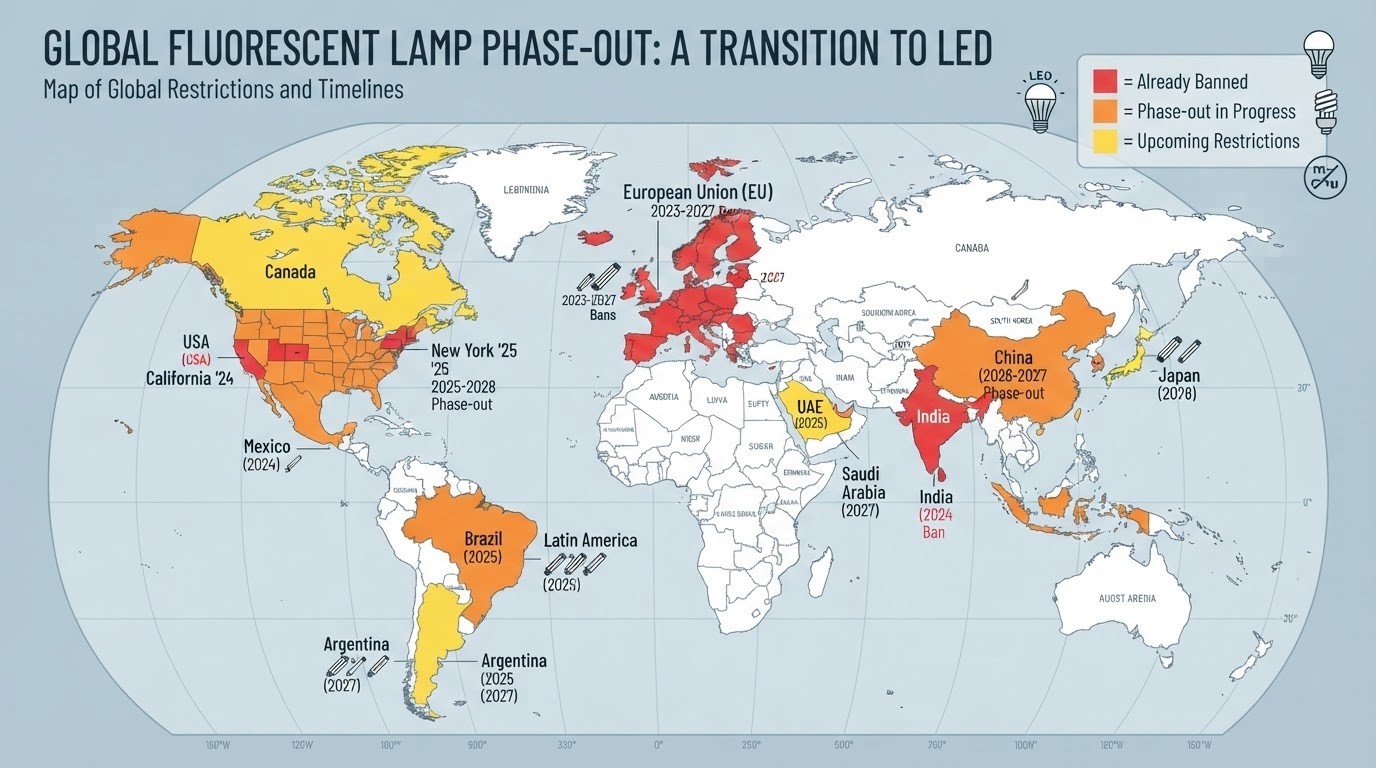
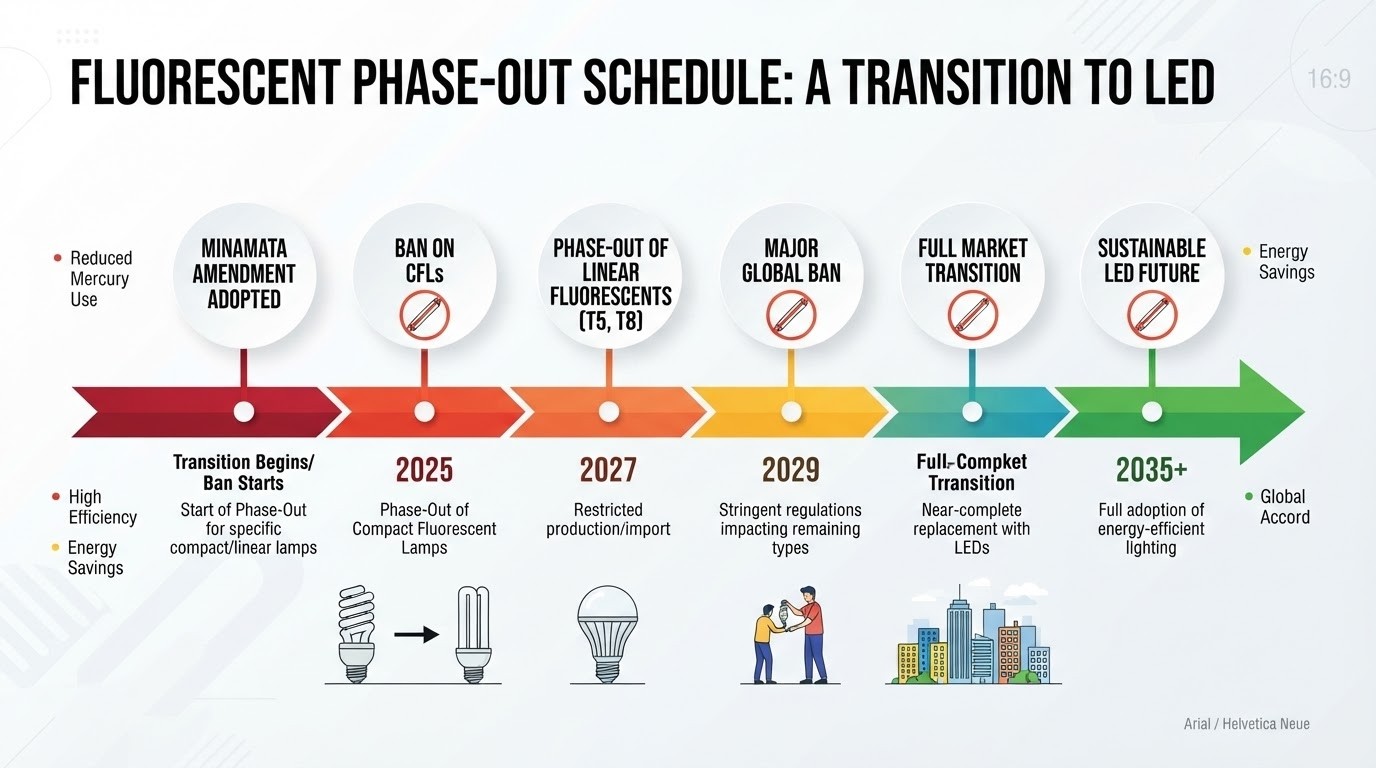
In November 2023, delegates from 147 countries at the Minamata Convention on Mercury (COP5) agreed to phase out the manufacture, import, and export of all fluorescent lamps for general lighting by 2027. Not reduce. Not discourage. Eliminate.
This is not a proposal sitting in committee. It is a binding international treaty. Europe has already enforced it. The United States, Canada, Japan, and Australia are executing it right now, state by state, province by province.
Here is exactly what is happening, where, when, and what you need to do about it.
Why Fluorescent Lamps Are Being Banned Worldwide
The reason is mercury. Every fluorescent tube — T8, T5, T12, CFL — contains mercury vapor as an essential operating component. Without mercury, the lamp does not produce light. It is not a trace impurity; it is the core technology.
Mercury is a persistent neurotoxin. When fluorescent tubes break during disposal — and the vast majority do, because most are thrown into general waste — mercury leaches into soil and water, bioaccumulates in the food chain, and causes irreversible neurological damage. The global lighting stock represents one of the largest remaining mercury use categories in the world.
The Minamata Convention, a United Nations treaty named after the Japanese city devastated by industrial mercury poisoning, was specifically designed to end this. The COP5 decision to eliminate all fluorescent lamps for general lighting is the final step in that process.
According to CLASP, the appliance efficiency expert group that advised the convention, the full global transition from fluorescent to LED by 2027 will deliver cumulative benefits through 2050 of 2.7 gigatonnes of avoided CO₂ emissions, 158 tonnes of eliminated mercury pollution, and US$1.13 trillion in electricity bill savings.
The Global Ban Timeline: Region by Region
This is the part you need to bookmark. Every region is on a slightly different schedule, but they are all converging on the same endpoint: no more fluorescent lamps by the end of 2027.
European Union — Already Enforced
The EU banned the production and import of T5 and T8 fluorescent tubes on August 24, 2023 under the updated RoHS (Restriction of Hazardous Substances) Directive. Compact fluorescent lamps were banned even earlier, from February 24, 2023. Europe is already fully post-fluorescent. Existing stock can still be used, but no new tubes can be manufactured, imported, or sold.
This matters to you even if you are not in Europe, because Europe was one of the world's largest fluorescent lamp markets. When that demand disappeared overnight, global manufacturing economics shifted. Factories closed production lines. Supply chains contracted. The tubes your distributor stocks today are being produced in smaller volumes at higher cost.
United States — Rolling State-by-State Bans (2024–2027)
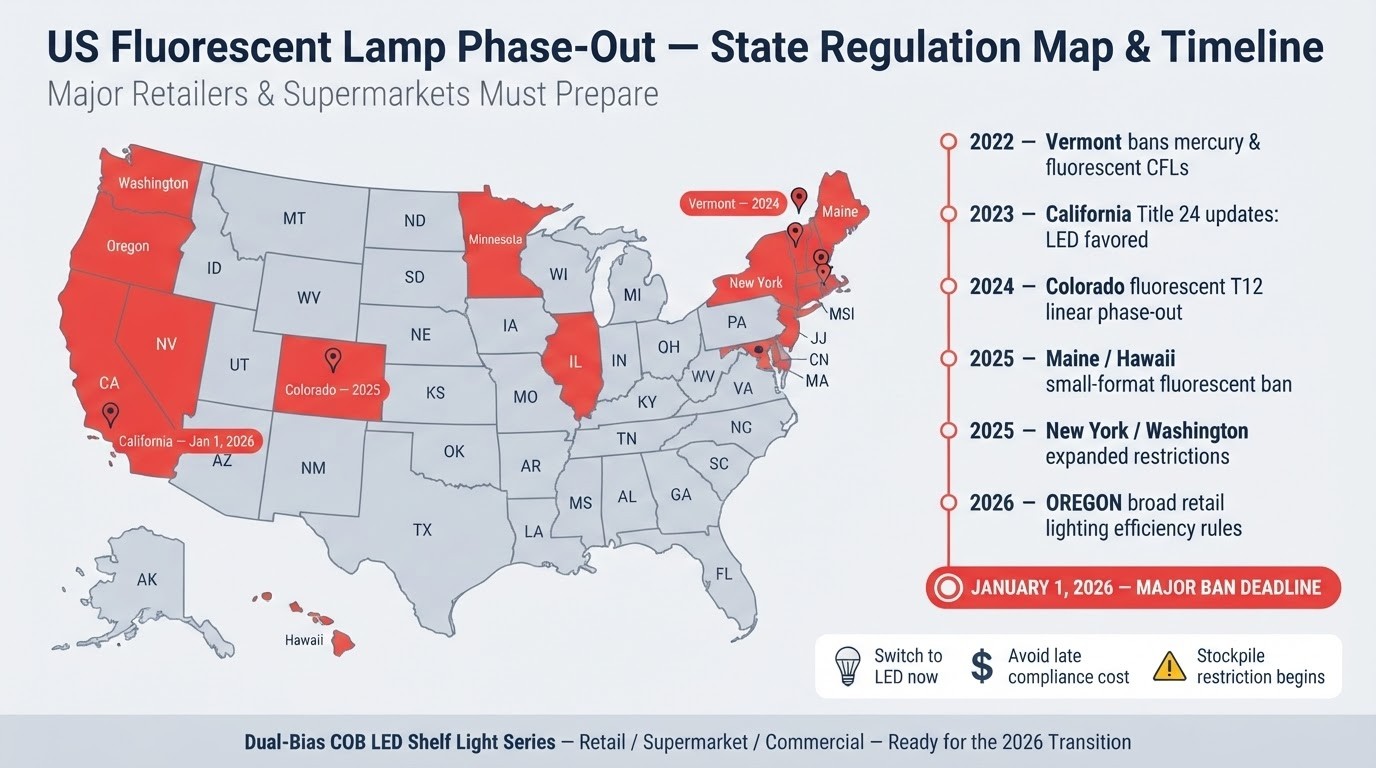
There is no single federal ban in the US. Instead, individual states are enacting their own legislation. As of mid-2026, nine states have active fluorescent bans, with more in the pipeline.
California and Vermont led the way, banning CFL sales from January 1, 2024 and linear fluorescent lamps (T5, T8, T12) from January 1, 2025. Colorado, Oregon, Washington, Rhode Island, Hawaii, Minnesota, and Maine followed with bans phasing in through 2025 and 2026. Illinois has a linear fluorescent ban taking effect January 1, 2027.
Bills are currently under consideration in New York, Massachusetts, Connecticut, New Jersey, and Virginia. The pattern is unmistakable — a national-scale phase-out is underway, with or without federal legislation.
A critical point: even if your store is in a state without a ban, you will still feel the impact. As manufacturers reduce production to match shrinking legal markets, supply nationally becomes thinner, lead times stretch, and prices rise. If you are planning to 'stock up' on fluorescent tubes, you are buying time, not a solution.
Canada — Full Ban Effective January 1, 2026
Canada's ban is already in force. As of January 1, 2026, the manufacture and import of screw-based CFLs, linear fluorescent lamps, and non-linear fluorescent lamps are prohibited nationwide. Canada did not do a state-by-state approach — it went national in one step.
Japan — Production Ban by End of 2027
Japan approved a ban on the production and trade of fluorescent lamps under the Minamata Convention framework. Incandescent fluorescent lamps were banned from January 2026, compact fluorescent lamps follow from January 2027, and straight-tube fluorescent lamps face a complete production and trade ban by the end of 2027. A survey by Mainichi found that over 40% of Japanese citizens were unaware of the upcoming ban — if you are reading this article, you are ahead of most of the market.
Australia — Phase-Out Through 2026–2027
Australia is a Minamata Convention signatory and is following the global timeline. Halophosphate T8 tubes (the most common type in older commercial buildings) face a 2026 ban on manufacture and import. Higher-quality tri-band phosphor T8 and all T5 tubes are banned by 2027. State-level rebate schemes in New South Wales (ESS), Victoria (VEU), and South Australia (REPS) are currently active to subsidize upgrades — but they will not last indefinitely.
What This Means for Supermarket and Retail Store Owners
Let us be very specific about the practical consequences, because the policy language can make this feel abstract when it is anything but.
You can still use your existing fluorescent tubes. No ban anywhere makes it illegal to operate a fluorescent lamp that is already installed. The bans target manufacturing, import, and sale of new lamps.
But when a tube fails, you cannot replace it. That is the real mechanism. In regions where the ban is active, replacement tubes are no longer being shipped. Existing distributor stock depletes quickly. Specialty variants disappear first. Standard T8s follow.
Emergency replacements cost more. When your store has dark shelves and the tube you need is out of stock, you pay a premium — for whatever LED solution can be fitted into an unfamiliar fixture, for the after-hours electrician, for the lost sales while aisles sit in shadow. A planned upgrade done on your schedule, in bulk, at negotiated prices, is always cheaper than a forced one.
Supermarkets are disproportionately affected. Lighting accounts for approximately 25–35% of a typical supermarket's total energy consumption. When combined with refrigeration, those two systems represent over 50% of energy use. Energy costs can reach 10–15% of a supermarket's total operating budget. Every dollar saved on lighting drops directly to the bottom line — and the fluorescent-to-LED conversion is one of the highest-ROI upgrades available.
The numbers are straightforward: a standard 36W fluorescent tube with ballast losses draws approximately 42W. An equivalent LED replacement draws 15–22W while producing the same or better light output. That is a 47–64% reduction in energy consumption per fixture. For a supermarket running 250 fixtures at 14 hours per day, that translates to roughly $8,000–$12,000 in annual electricity savings, depending on local energy rates.
How to Upgrade: A Practical Roadmap for Store Owners
There is no single right answer for every store, but there is a clear decision framework.
Step 1: Audit What You Have
Before you spend anything, document your existing fluorescent fixtures — location, tube type (T8, T5, T12), wattage, ballast type (magnetic or electronic), and condition. This takes a few hours for a typical store and is the foundation for everything else.
Step 2: Choose Your Upgrade Path
You have two broad options.
The first option is a tube-for-tube retrofit: replace fluorescent tubes with LED retrofit tubes that fit into existing fixtures. This is the lowest upfront cost but leaves the old ballast in place (Type A install) or requires ballast bypass wiring (Type B install). Type B is strongly recommended because ballasts are the most failure-prone component and leaving them creates a future maintenance liability.
The second option is a full fixture upgrade: replace the entire fluorescent fixture with a purpose-built LED solution. Higher upfront cost, but better light quality, longer warranty, and zero legacy components. For shelf-level lighting in supermarkets, this is where modern track-mounted LED spotlights with specialized optics deliver the biggest performance improvement.
Step 3: Prioritize by Impact
Do not try to convert your entire store in one project unless your budget allows it. Start with the areas where lighting has the highest commercial impact: fresh produce, meat and deli counters, bakery displays, and high-traffic promotional end-caps. These are the sections where better light directly drives higher sales.
For gondola aisle shelving — which typically suffers the worst shadow problems from overhead-only lighting — dedicated track-mounted LED spotlights with asymmetric deflection optics push light forward and down onto products, eliminating the shadow zones that overhead lights cannot reach. These systems mount on a three-wire rail above each shelf run, making future shelf reconfigurations painless.
Step 4: Capture Available Incentives
Many regions offer rebates, tax credits, or utility incentives for fluorescent-to-LED upgrades. In the United States, the federal 179D Energy Efficient Tax Deduction allows businesses to claim up to $5.00 per square foot for qualifying lighting installations. State utility companies frequently offer per-fixture rebates. In Australia, the NSW ESS and VIC VEU schemes can cover a significant portion of upgrade costs.
These incentive programs are designed to accelerate conversion while legacy stock is still large. As more businesses upgrade and the unconverted base shrinks, incentive values will decrease. The window is open now.
Step 5: Plan for Color and Performance, Not Just Efficiency
If you are going to upgrade anyway — and the ban ensures you will — do not settle for the cheapest LED that fits the socket. Invest in light quality that drives revenue.
For supermarkets and retail stores, three specifications matter most. CRI (Color Rendering Index) should be 90 or above — this makes fresh food look vibrant and merchandise look premium. Anything below CRI 85 and your products look flat. Color temperature should be matched by zone: 3000K warm white for bakery and bread, 4000K neutral white for general aisles, and 4500–5000K cool white for dairy, frozen, and seafood. And beam optics should match the application: wide flood for general aisle lighting, narrow spot or asymmetric deflection for shelf-level product highlighting.
The Cost of Waiting vs. The Cost of Acting Now
This is not a 'nice to have' upgrade that you can push to next year's budget indefinitely. The ban has a hard endpoint. Here is a realistic comparison:
Planned upgrade (2026): You control the timeline. You negotiate bulk pricing. You capture available rebates and tax incentives. You choose the best-performing LED products for your application. You install during low-traffic hours with minimal disruption. Total cost is predictable and ROI begins immediately.
Forced upgrade (2028+): Fluorescent tubes fail and cannot be replaced. You pay emergency rates for whatever LED product is available. You lose sales revenue from dark shelves while waiting for installation. You miss the rebate window. Your total cost is higher and your ROI is delayed.
The LED payback period has never been shorter. Global analysis shows that the average payback period for an LED replacement of a linear fluorescent lamp dropped from 6.3 months in 2022 to 2.4 months in 2023, and continues to improve as LED prices fall and energy costs rise.
The Bottom Line
The fluorescent era is ending. Not gradually, not theoretically — it is ending on a fixed, binding, international timeline. The EU is already done. Canada is done. The US is more than halfway there. Japan and Australia will cross the finish line by 2027.
If you operate a supermarket or retail store anywhere in the world, this is not a question of whether you will switch to LED. It is a question of whether you do it on your terms or on the ban's terms.
The stores that plan ahead will spend less, perform better, and never have a dark shelf. The ones that wait will pay more for worse outcomes. The data, the policy, and the economics all point in exactly one direction.
Start with one aisle. See the difference. Then scale.
Related reading on igoeser.com:
- Does LED Shelf Lighting Really Increase Supermarket Sales?
- LED vs Fluorescent Shelf Lighting: Which One Saves More for Retailers?

点击右上角
分享给朋友吧







 Long by picture save/share
0


CONTACT US
 4F. ***5, ErJia Village, Xilian, JingSha, Danzao Town, Nanhai Dist, Foshan, GuangDong, PRC.
 0086 136 3007 3564

 Whatsapp / Wechat: +86 1363 0073 564
© Copyright 2023-2024 Foshan GuanSheng Technology Co., Ltd. All Rights Reserved.
