

- Español
- 中文
News
LED vs Fluorescent Shelf Lighting: Which Saves More for Retailers?
Author:Foshan Guansheng Technology Co., Ltd.
Click:
Time:2026-07-15 14:53:32
LED vs Fluorescent Shelf Lighting: Which Saves More for Retailers?
Introduction: The Real Question Is Not 'Which Is Cheaper?' — It Is 'Which Costs Less Over Five Years?'
If you are running a supermarket, grocery chain, or retail store, lighting is not a minor line item. According to the U.S. Environmental Protection Agency, refrigeration and lighting together account for over 50% of total energy consumption in the average supermarket. Lighting alone typically represents 15–25% of a grocery store's electricity bill (Energy Broker TX), and energy costs can eat up to 10% of total operating expenses (University of Illinois EnergySense).
For a business running on 1–3% net margins, every dollar saved on lighting drops straight to the bottom line.
Fluorescent tubes have been the standard shelf and overhead lighting solution in retail for decades. They were a legitimate improvement over incandescent systems when they were introduced. But the technology landscape has shifted dramatically, and the question retailers now face is straightforward: does it still make financial sense to keep running fluorescent shelf lights, or is it time to switch to LED?
This article puts the two technologies side by side — not with opinions, but with numbers.
Energy Consumption: The Biggest Cost Driver
The most immediate and measurable difference between LED and fluorescent shelf lighting is electricity consumption.
A standard 4-foot T8 fluorescent tube consumes 32–40 watts. A comparable LED shelf light — whether it is a tube retrofit or a purpose-built linear fixture like the Anti-Glare Double Deflection LED Linear Track Spot Light — delivers equal or greater lumen output at 15–22 watts. That is a 40–55% reduction in wattage at the fixture level.
But the real-world savings are often even larger than the fixture-level numbers suggest. A study from the University of Michigan found that LED systems are up to 44% more efficient than 4-foot fluorescent tubes when total system losses (including ballast inefficiency) are accounted for (University of Michigan SEAS). The U.S. Department of Energy's own assessment puts LED systems at a minimum of 25% more energy-efficient than fluorescent equivalents.
Here is what that looks like in practice for a mid-sized supermarket:
| Metric | Fluorescent (T8) | LED Shelf Light |
|---|---|---|
| Wattage per 4-ft fixture | 32–40 W | 15–22 W |
| Number of shelf fixtures (200 linear ft, 5 tiers) | 250 | 250 |
| Total system wattage | 8,000–10,000 W | 3,750–5,500 W |
| Daily runtime (14 hrs) | 112–140 kWh | 52.5–77 kWh |
| Monthly electricity cost (@ $0.12/kWh) | $403–$504 | $189–$277 |
| Annual electricity cost | $4,838–$6,048 | $2,268–$3,326 |
| Annual saving with LED | — | $1,512 – $3,780 |
That is $1,500 to nearly $4,000 saved every year on electricity alone — from shelf lighting on 200 linear feet of gondola. Scale that to a chain of 20, 50, or 100 stores, and the numbers become impossible to ignore.
Lifespan: How Often Are You Replacing Fixtures?
Fluorescent tubes are rated for 10,000–15,000 hours of operation. In a supermarket running 14 hours per day, that means a fluorescent tube lasts approximately 2 to 3 years before it needs replacement. And performance degrades well before complete failure — fluorescent lamps typically lose 20–30% of their lumen output within the first year, a phenomenon known as lumen depreciation.
LED shelf lights, by contrast, are rated for 50,000–120,000 hours. At 14 hours per day, that is 10 to 23 years of service life. High-quality commercial LED fixtures maintain over 90% of their initial lumen output at the L90 mark (the point where output has dropped to 90% of original), which is typically reached well past the 50,000-hour mark.
| Metric | Fluorescent | LED |
|---|---|---|
| Rated lifespan | 10,000–15,000 hrs | 50,000–120,000 hrs |
| Years at 14 hrs/day | 2–3 years | 10–23 years |
| Replacements over 10 years | 3–5 cycles | 0–1 cycle |
| Lumen depreciation at year 1 | 20–30% loss | < 5% loss |
Every replacement cycle involves not just the cost of the tube itself, but the labor to access the fixture, remove the old tube, install the new one, and dispose of the old one properly. In a store with hundreds of shelf-level fixtures, this is not trivial.
Maintenance: The Hidden Cost That Tips the Scale
Maintenance is where the financial gap between fluorescent and LED shelf lighting becomes dramatic.
Fluorescent shelf lighting systems include not only the tube itself but also a ballast — the electrical component that regulates power to the tube. Ballasts fail independently of the tube and typically need replacement every 3–5 years. A ballast failure means the entire fixture goes dark until a technician replaces it. This creates unplanned downtime, dark sections of shelving (which directly impacts sales), and emergency maintenance calls.
LED shelf lights — particularly modern rail-mounted systems — do not use ballasts. The driver (the LED equivalent of a ballast) is built for the same extended lifespan as the LED module itself and operates far cooler, which dramatically reduces failure rates.
Industry data from USAI Lighting indicates that annualized maintenance costs for fluorescent lighting systems run approximately $38.93 per fixture per year, while LED systems average roughly $1.20 per fixture per year (USAI Lighting). For a store with 250 shelf fixtures, that is a difference of:
- Fluorescent: 250 × $38.93 = $9,733/year
- LED: 250 × $1.20 = $300/year
- Annual maintenance saving: $9,433
Read that number again. The maintenance saving alone is often larger than the total energy saving. This is the cost that most retailers underestimate when comparing the two technologies.
Light Quality: Not All Lumens Are Equal
Beyond cost, there is a fundamental quality difference that directly affects your core business — selling products.
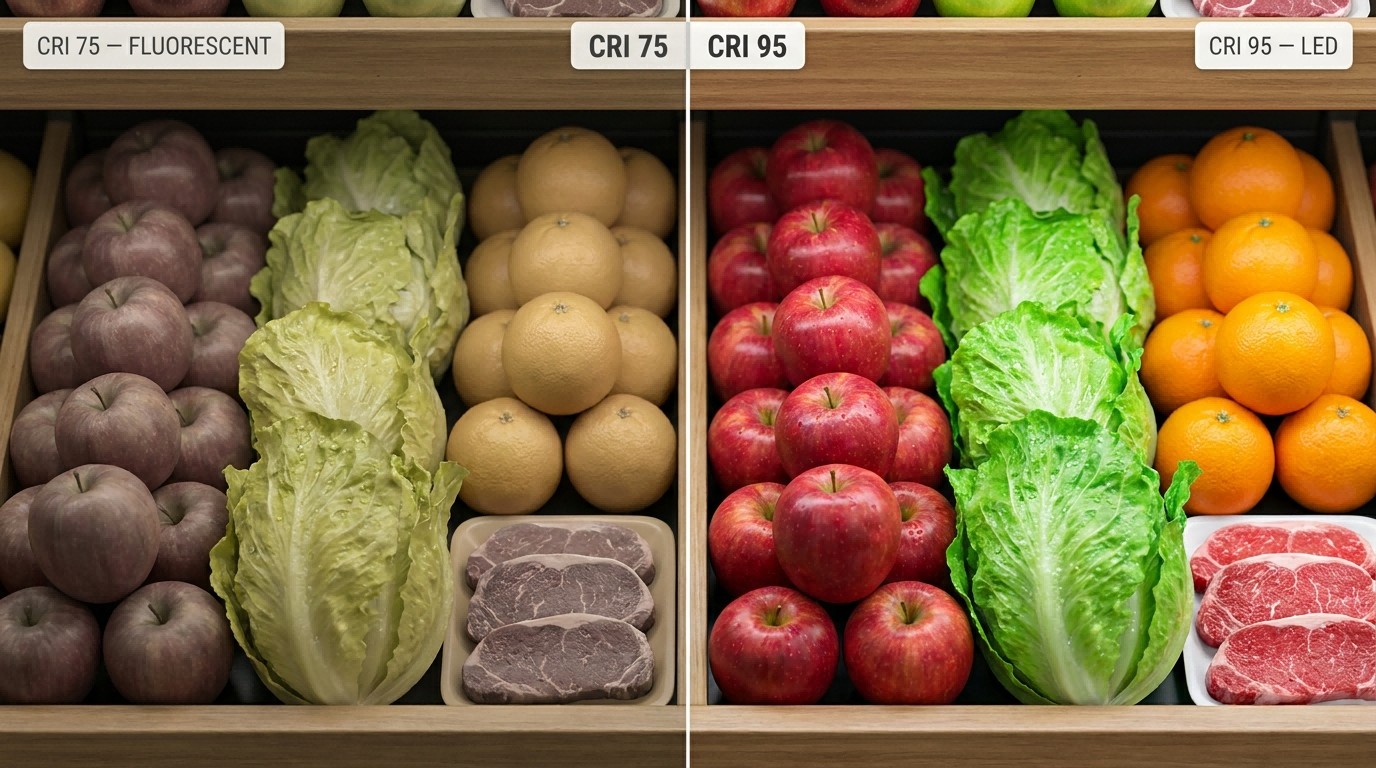
Fluorescent tubes produce light by exciting mercury vapor, which then activates a phosphor coating. This process creates visible light, but with a limited and uneven spectrum. Typical fluorescent CRI (Color Rendering Index) falls in the 70–82 range. Products lit by low-CRI fluorescent light appear washed out, dull, and less appealing.
LED shelf lights with CRI 90+ render colors far more accurately. Fresh produce looks greener and more vibrant. Meat appears richer. Packaging colors are true to their design intent. As we covered in our previous article, Does LED Shelf Lighting Really Increase Supermarket Sales?, this color accuracy directly translates to higher product noticeability and increased sales.
There is also the issue of light direction. Fluorescent tubes emit light in all directions — a significant portion of the light goes upward into the shelf above, sideways into the aisle, or backward into the wall, where it serves no useful purpose. This is wasted energy that produces zero sales impact.
Purpose-built LED shelf lights use asymmetric optics (single or double deflection lenses) to direct virtually all light forward and downward onto the product face. This means you get more useful light on the product from fewer watts — a double efficiency advantage.
The Regulatory Elephant in the Room: Fluorescent Phase-Outs
Even if the energy, maintenance, and quality arguments were not compelling enough, there is now a regulatory reality that makes the transition to LED unavoidable.
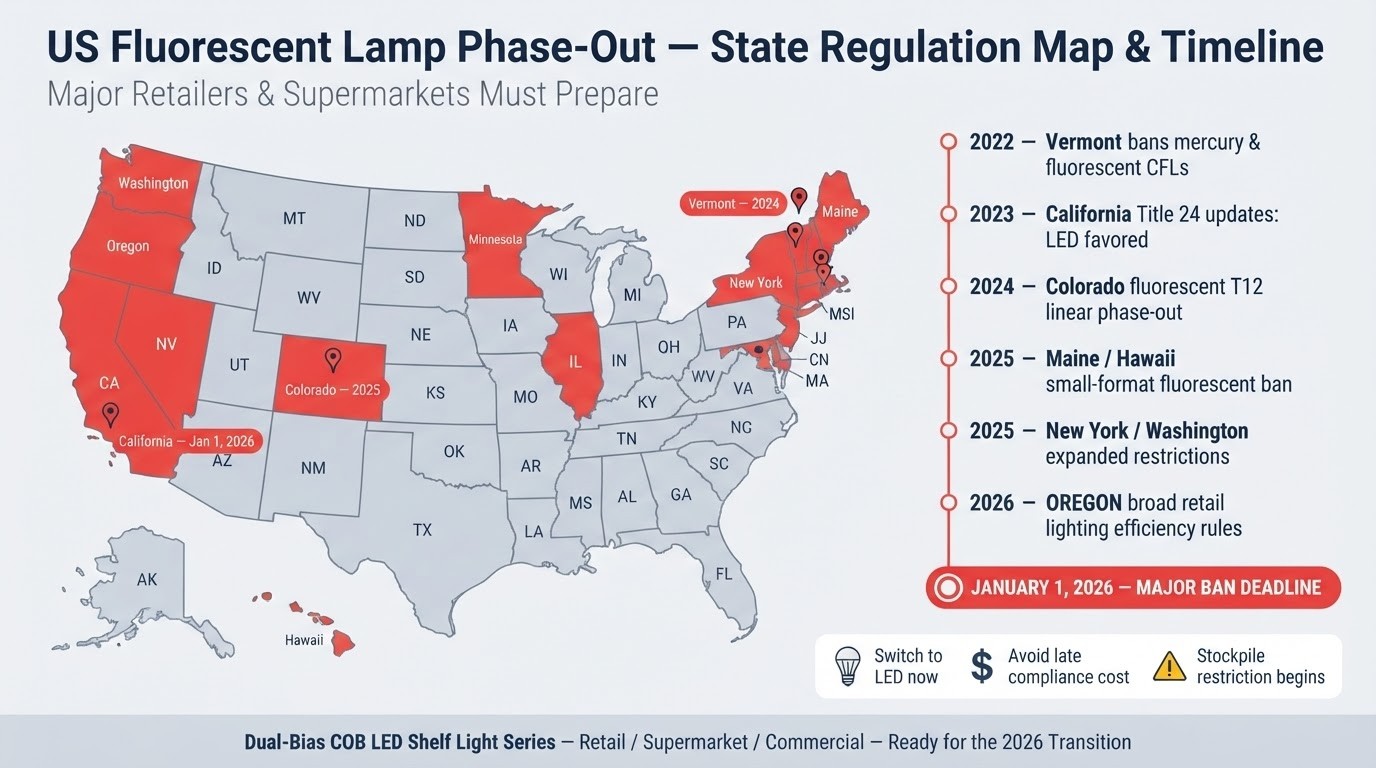
Multiple U.S. states have enacted legislation to phase out the sale of fluorescent tubes:
- California and Vermont have already banned standard fluorescent lamps.
- Colorado, Oregon, Rhode Island, Maine, Hawaii, and others have phase-out timelines in effect.
- January 1, 2026 marks a major deadline in several states, extending the ban to include pin-base compact fluorescent lamps and linear fluorescent tubes (T5, T8, and T12) (LEDVANCE).
For retailers operating in these states — or planning to expand into them — continued investment in fluorescent shelf lighting is not just financially suboptimal, it is increasingly non-compliant.
Beyond the U.S., the European Union's RoHS Directive has already restricted mercury-containing lamps, and similar regulations are rolling out across Asia, the Middle East, and Latin America.
The fluorescent tube you install today may not be replaceable in 2–3 years when it burns out.
Environmental and Safety Considerations
Fluorescent tubes contain mercury — a toxic heavy metal that requires special handling and disposal. The U.S. EPA mandates specific disposal procedures for fluorescent lamps, and companies that improperly dispose of them can face fines of up to $25,000 (eledlights.com).
For a supermarket with hundreds of fluorescent shelf fixtures, this means ongoing compliance requirements, disposal logistics, and the ever-present risk of a broken tube releasing mercury vapor in a food retail environment.
LED shelf lights contain no mercury. They are classified as standard electronic waste at end of life. No special handling, no hazardous waste fees, no compliance risk.
Total Cost of Ownership: The Five-Year Comparison
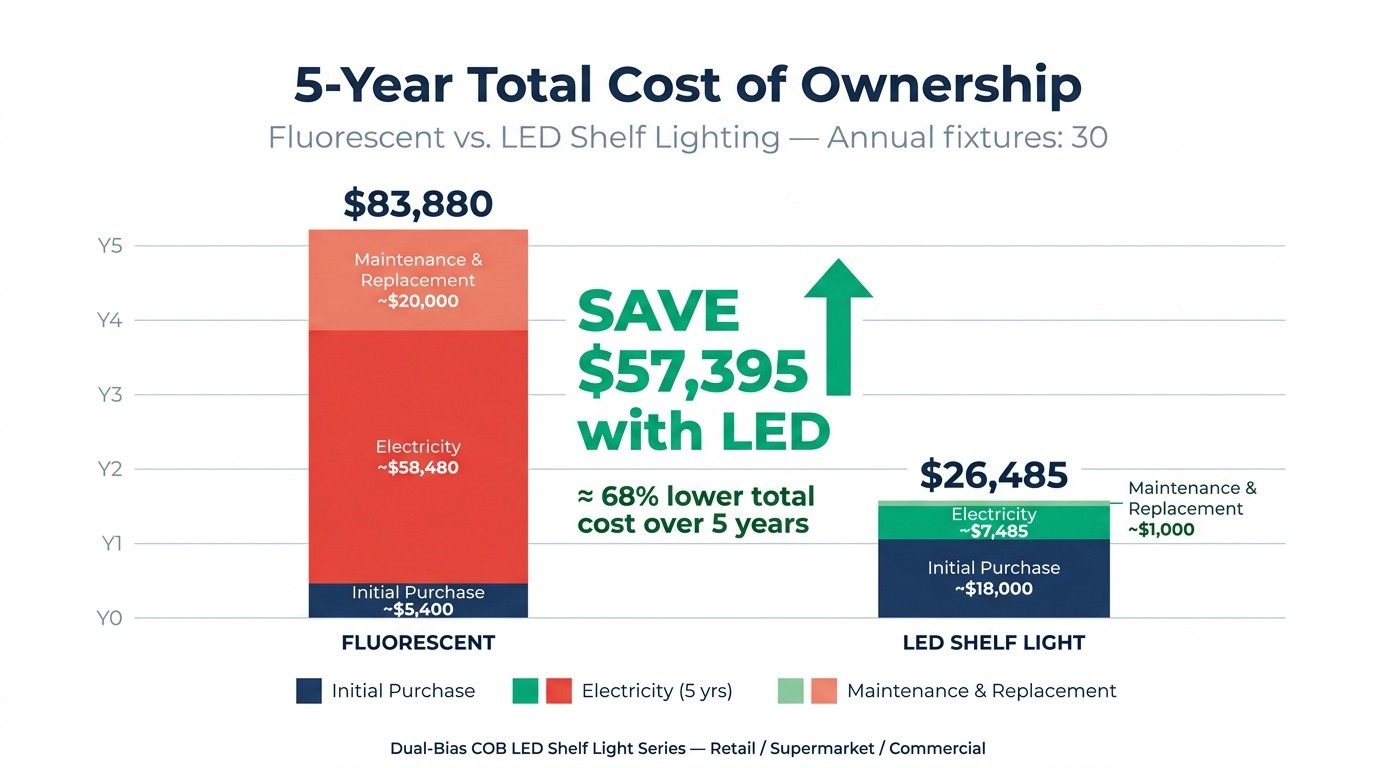
This is where everything comes together. Below is a side-by-side total cost of ownership comparison for a mid-sized supermarket with 250 shelf-level fixtures, operating 14 hours per day, 365 days per year.
| Cost Category | Fluorescent (5-year) | LED (5-year) |
|---|---|---|
| Fixture purchase (250 units) | $2,500 ($10/unit) | $7,500 ($30/unit) |
| Installation (rail system for LED) | $1,000 | $3,500 |
| Electricity (annual × 5) | $27,215 | $13,985 |
| Maintenance (annual × 5) | $48,665 | $1,500 |
| Tube/lamp replacements (5 years) | $3,750 (3 cycles × $5/tube × 250) | $0 |
| Mercury disposal fees (5 years) | $750 | $0 |
| Total 5-year cost | $83,880 | $26,485 |
| 5-year saving with LED | — | $57,395 |
The LED system costs three times more to purchase and install. And then it saves $57,395 over five years — a return of more than 8× the incremental upfront investment.
This is not a marginal improvement. It is a fundamental shift in the cost structure of shelf lighting.
When Does It Make Sense to Keep Fluorescent?
To be fair: there are limited scenarios where immediate fluorescent replacement may not be the top priority. If a store is scheduled for a full remodel within 12 months, it may make sense to coordinate the lighting upgrade with the broader renovation to reduce total labor costs. If a lease is expiring within 18 months with no renewal intention, the payback window may be too short.
But for any store that plans to operate in its current location for 3 or more years, the financial case for LED shelf lighting is overwhelming.
Frequently Asked Questions
Q: My fluorescent shelf lights still work. Should I wait until they fail to switch?
No. The energy and maintenance costs you are paying every month while waiting exceed the cost of proactive replacement. The University of Michigan study specifically found that replacing functioning fluorescent tubes with LED is more cost-effective than waiting for end-of-life replacement.
Q: Can I just put LED tubes into my existing fluorescent fixtures?
In some cases, yes — plug-and-play Type A LED tubes can replace fluorescent tubes in existing fixtures without rewiring. However, for shelf lighting specifically, purpose-built LED shelf light fixtures with proper optics (asymmetric deflection lenses) will dramatically outperform a simple tube swap in terms of light quality, efficiency, and product visibility.
Q: How do I handle different lighting needs across store zones?
LED shelf lights are available in a range of color temperatures — from 2700K (warm, for bakery and deli) to 5000K (cool, for frozen and dairy). Unlike fluorescent tubes, which are difficult to source in varied CCTs, LED systems make it simple to deploy different color temperatures across different zones within the same three-wire rail system.
Q: What about dimming? My fluorescent fixtures do not dim well.
This is actually one of LED's strongest advantages. LED shelf lights offer smooth, flicker-free dimming across a wide range (typically 0–100%). Fluorescent tubes dim poorly, flicker at low levels, and have reduced lifespan when dimmed frequently. If you want the ability to adjust brightness by zone or time of day, LED is the only practical option.
Q: Are fluorescent tubes being banned?
Yes, in a growing number of U.S. states and internationally. As of January 1, 2026, several U.S. states ban the sale of linear fluorescent tubes (T5, T8, T12) and pin-base compact fluorescent lamps. The European Union has similar restrictions under its RoHS Directive.
Conclusion: The Math Does Not Lie
The comparison between LED and fluorescent shelf lighting is no longer a debate — it is an arithmetic problem. LED costs more upfront. It costs dramatically less to operate. It produces better light. It lasts 5–10× longer. It requires almost no maintenance. It contains no toxic materials. And it is increasingly the only legal option.
For retailers serious about controlling operating costs and maximizing product visibility on every shelf, the switch to LED is not a question of 'if' but 'when.' And the data says the answer to 'when' is now.
Ready to see the numbers for your specific store? Contact our engineering team for a free energy and ROI calculation based on your store dimensions and current lighting setup. Or explore our Anti-Glare LED Linear Track Spot Light range to see what purpose-built shelf lighting looks like.
Internal Link Map:
- 'Does LED Shelf Lighting Really Increase Supermarket Sales?' → /NewsDetail/8153322.html
- 'How to Choose the Right Shelf Lighting for Your Supermarket' → /NewsDetail/8129986.html
- 'Anti-Glare Double Deflection LED Linear Track Spot Light' →
- 'three-wire rail system' →
- 'contact our engineering team' → /contact/
- 'LED Shelf Light range' → /products/led-shelf-light/
Schema Markup:
- Article (BlogPosting) schema
- FAQ schema for the 5 Q&A pairs
- BreadcrumbList: Home > Blog > LED vs Fluorescent Shelf Lighting

点击右上角
分享给朋友吧







 Long by picture save/share
0


CONTACT US
 4F. ***5, ErJia Village, Xilian, JingSha, Danzao Town, Nanhai Dist, Foshan, GuangDong, PRC.
 0086 136 3007 3564

 Whatsapp / Wechat: +86 1363 0073 564
© Copyright 2023-2024 Foshan GuanSheng Technology Co., Ltd. All Rights Reserved.
